 Projections
 Sign up for the FanDuel Research daily email newsletter!
 Horse Racing
 Soccer
 WNBA
WNBA NASCAR
 UFC
UFC Golf
Golf NCAAB
NCAAB Tennis
 Boxing
 Casino
 Canada
 Sports Betting 101
 TV & Podcasts
 NFL
NFL MLB
MLB NCAAF
NCAAF Horse Racing
 NBA
NBA NHL
NHL Canada
 FanDuel Sportsbook Promos
  Email Sign-Up


How to Play Blackjack: Rules, Strategies & Gameplay Guide

Basic Rules and Objectives
Blackjack, sometimes referred to as "twenty-one," is a card game with a simple objective: beat the dealer by either getting your total as close to 21 as possible without going over, or watching the dealer bust. Each round, you place a wager, get dealt two cards, and then decide whether to hit (take an additional card), stand (take the total on your cards), double down (double your bet and take one additional card), split pairs, or (at some tables) surrender and receive half of your stake back.
The dealer goes last and must then play their hands according to fixed rules, and hit (take cards) until their total is at least 17, and in some cases, the dealer must draw on a so-called "soft" 17 (a total of 17 with an ace facing as 11).
Generally, card values are simple: numbered cards have points equal to their face values, face cards (J, Q, K) are worth 10 points, and an ace can have 1 or 11 points in any hand. A “blackjack” is defined as an ace plus any ten-value card (10, J, Q, or K) on the first deal of the hand; the hand beats anything made by the dealer, unless the dealer also gets a blackjack.
Blackjack uses standard 52-card decks, but casinos shuffle multiple decks together/break them into piles. Casinos will deal from a "shoe" that could contain anywhere from one to eight decks. Each additional deck increases the house edge slightly, so single-deck blackjack is more favorable to the player.
Player rules are significantly affected by dealer house rules as well; in particular, rules related to soft 17. If the dealer must draw a card when they have a soft 17, the dealer's edge increases by roughly 0.2 percentage points compared to a dealer standing with a soft 17.
This video covers the basic rules and objectives of blackjack to help you learn how to play the game in under two minutes!
How to Play a Hand of Blackjack
- Place your bet before any cards are dealt. You’re betting on the likelihood of your hand being higher than the dealer’s without exceeding 21.
- Cards are dealt: You and the dealer each receive two cards. The dealer shows one card face up, which helps you make informed decisions.
- Player decisions:
- Hit – Request another card to increase your total.
- Stand – Keep your current hand.
- Double Down – Double your original bet; you receive one additional card and must stand.
- Split – If your first two cards are of the same value, you can split them into two hands and place an additional bet of the same amount. Each hand is then played separately.
- Surrender – Some tables allow you to give up half your bet immediately. Late surrender (after the dealer checks for blackjack) is common; early surrender (before the check) is rare.
- Dealer’s turn: after you finish, the dealer reveals their second card and must draw according to house rules. If your total is higher than the dealer’s without exceeding 21, or if the dealer busts, you win.
Blackjack Bets and Options
Standard bet
You place your main wager before the cards are dealt. Winning nets you 1:1 on your bet, but if you are able to achieve a blackjack, the typical payout is 3:2, meaning a $10 stake returns $15 profit. Some tables pay 6:5 or 1:1 on blackjack, which increases the house edge. A 3:2 payout game has an average house edge of about 0.5%, while a 6:5 game can raise the house edge to around 2%.
Splitting pairs
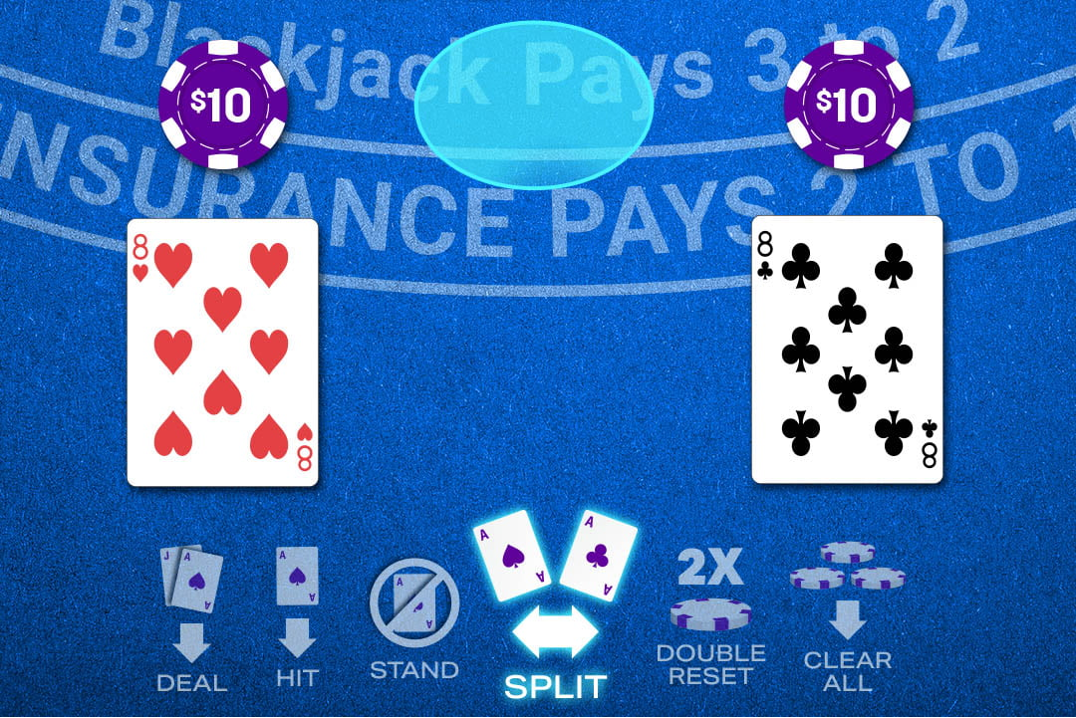
If your first two cards have the same value, you may split them into two separate hands for an additional bet.
The best times to split pairs
- Always split aces and eights: Two aces split into two strong starting hands, and a pair of eights (16) is a weak total that is improved by splitting.
- Never split tens or fives: A total of 20 is already strong, and a pair of fives gives you 10, a good hand for doubling down.
- Pair of nines: Split when the dealer shows a 2 through 6 or 8‑9; stand on a 9‑9 against a dealer 7.
- Sevens: Split against dealer 2‑7; otherwise hit.
- Sixes: Split against dealer 2‑6; otherwise hit.
- Fours: Split only when doubling after split is allowed and the dealer shows 5 or 6; otherwise hit.
- Twos or threes: Split if the dealer shows 2‑7; otherwise hit.
Doubling down
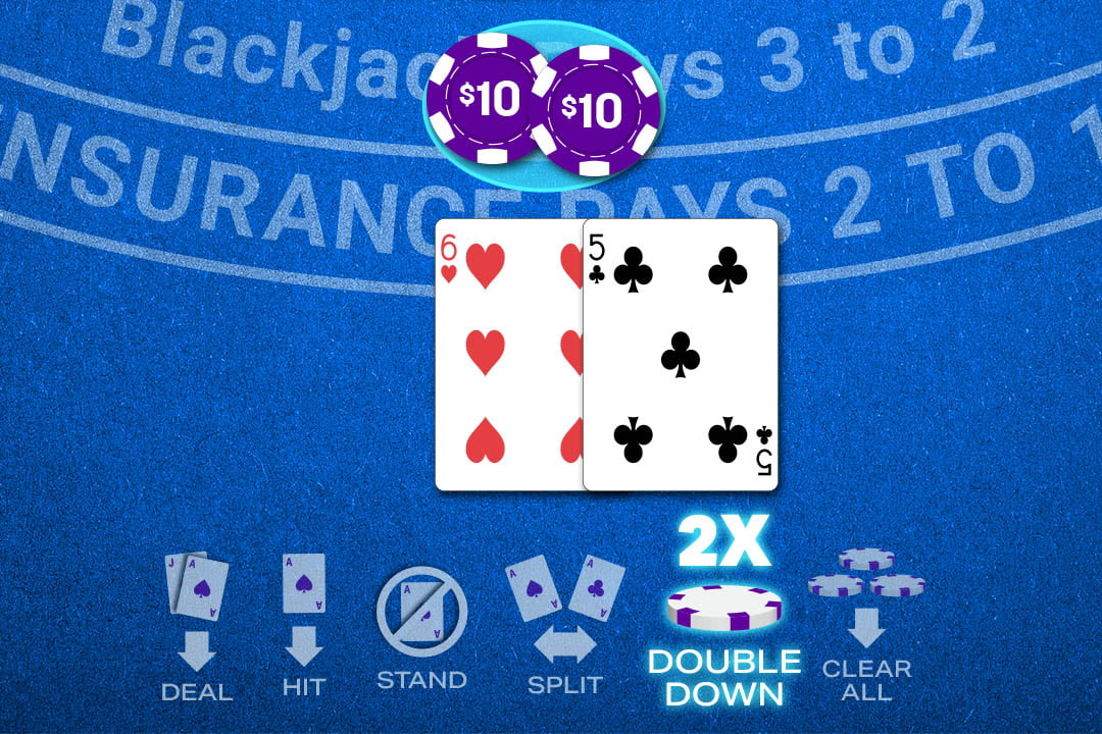
After receiving your first two cards, you can choose to double your bet by “doubling down” and taking exactly one more card. This is a smart move when you think one card could really boost your total, especially if the dealer’s upcard isn’t very strong.
This video will introduce you to the basics of what it means to “double down” in blackjack, and share helpful tips on when to consider doubling down to boost your chances of winning.
When to double down
- Always double on 11: There is a high chance of receiving a ten‑value card, giving you 21.
- Double on 10 when the dealer shows 2‑9.
- Double on 9 against dealer 3‑6.
- Double soft 16‑18 (A‑5, A‑6, or A‑7) when the dealer shows 4‑6.
When to avoid doubling down
- Avoid doubling when the dealer’s upcard is 10 or ace, or when your hand already totals more than 11.
Insurance bet
When the dealer’s face‑up card is an ace, you may purchase insurance—a side bet of up to half your original stake that pays 2:1 if the dealer has blackjack. While that might sound like a good deal, the chance the dealer actually has blackjack is quite small, so this wager increases the house edge. FanDuel’s strategy guide explicitly advises players to avoid the insurance bet because its payoff is less than the odds of the dealer having a blackjack.
This video explains how the insurance bet works and when it can be useful.
Surrender
A surrender lets you fold your hand and get back half your stake. Early surrender, which occurs before the dealer checks for blackjack, lowers the house edge by about 62%. Late surrender (only allowed after the dealer checks and doesn’t have blackjack) is more common. Basic strategy suggests surrendering a hard 16 (except a pair of eights) against a dealer’s 9, 10, or ace, and a hard 15 against a dealer 10.
When to Hit and When to Stand
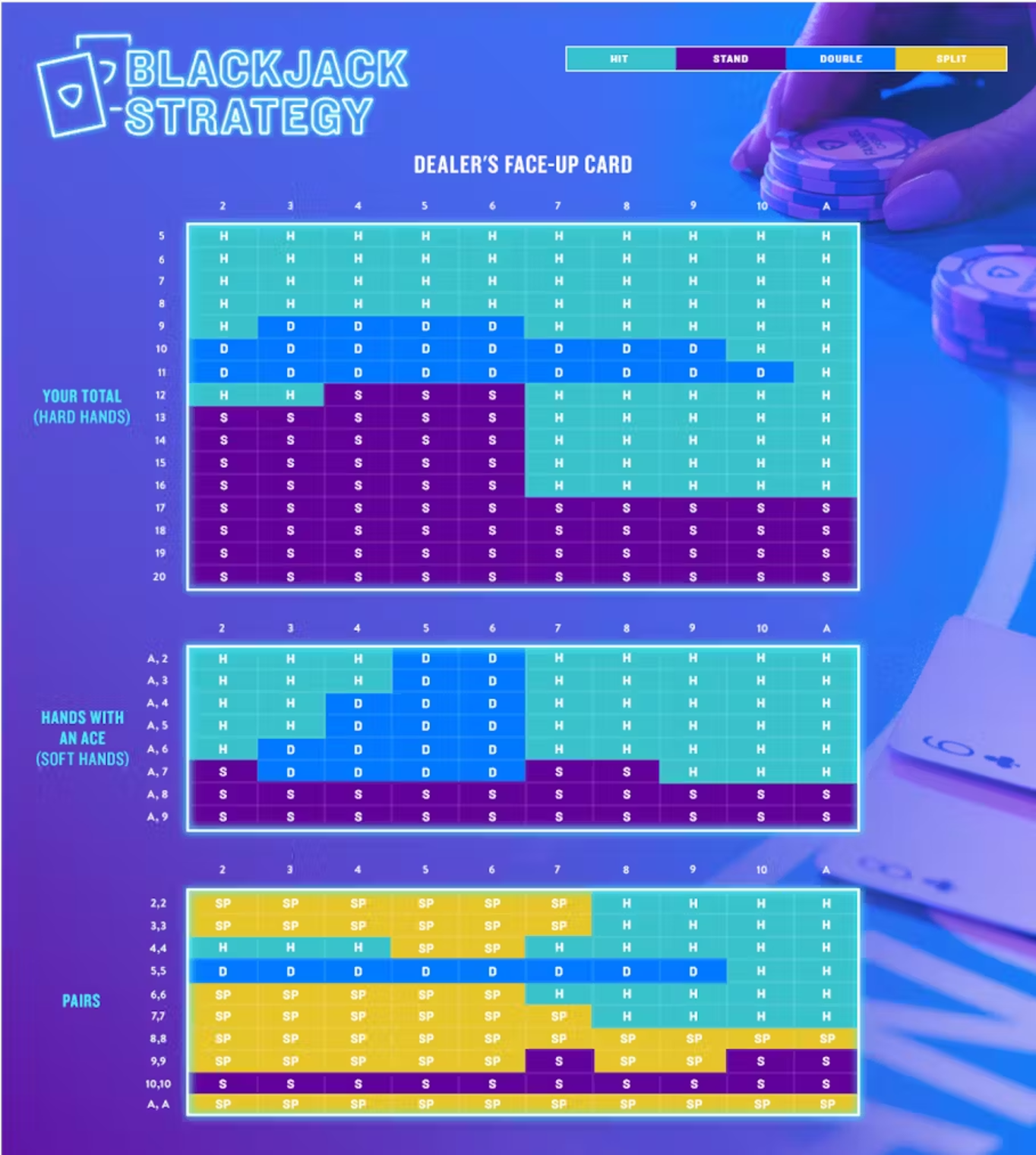
Your decision to hit or stand will depend on the hand you’re dealt versus the dealer’s face-up card. The chart below shows the ideal scenarios for when to hit, stand, double down, or split pairs.
Hard vs Soft Hands in Blackjack
A hard hand has no ace, while a soft hand includes an ace. Hard hands are “fixed” totals, and soft hands are flexible because the ace can switch between 1 and 11. The distinction matters when deciding whether to hit or stand:
Hard totals
Hard hand | Dealer shows | Recommended action |
|---|---|---|
| 17 or more | Any card | Stand |
| 16, 15, 14, or 13 | 2‑6 | Stand |
| 12 | 4‑6 | Stand |
| 11 | Any except ace | Double down |
| 10 | 2‑9 | Double down |
| 9 | 3‑6 | Double down |
| 8 or less | Any card | Hit |
Soft totals
Soft hand | Dealer shows | Recommended action |
|---|---|---|
| A,9 (soft 20) | Any card | Stand |
| A,8 (soft 19) | 6 | Double down; otherwise stand |
| A,7 (soft 18) | 2‑6 | Double down; vs 9‑A hit; otherwise stand |
| A,6 (soft 17) | 3‑6 | Double down; otherwise hit |
| A,5/A,4 (soft 16/15) | 4‑6 | Double down; otherwise hit |
| A,3/A,2 (soft 14/13) | 5‑6 | Double down; otherwise hit |
For all soft hands, if doubling isn’t allowed, follow the recommended hit or stand. When in doubt, remember that hard 17 always stands, whereas soft 17 usually calls for a hit because you cannot bust by drawing one more card.
Dealer’s upcard and odds
There are four times as many 10‑value cards in a deck, so when the dealer shows a 7, 8, or 9, their hidden card is likely a 10. That makes your hand of 18 or 19 less secure than it looks. For example, a basic strategy rule is to stand on a pair of 9s when the dealer shows a 7. Always consider the dealer’s upcard when deciding to hit, stand, split, or double.
Blackjack Payouts, Odds & RTP
Blackjack is appealing because of the low house edge. With a basic strategy, the house advantage in a 3:2 payout game can be around 0.5%. Many online blackjack games have a theoretical return to player (RTP) of 99%, meaning that over time, you might get back $99 for every $100 wagered. Conversely, switching to a 6:5 payout or tables where the dealer hits on soft 17 increases the house edge to around 2%. Keeping your basic strategy in mind helps you achieve the highest possible RTP.
Number of Decks & Dealer Rules
Blackjack is played with standard 52‑card decks, but casinos may use anywhere from one to eight decks. More decks slightly benefit the house by making card counting more difficult and reducing the value of certain plays (such as doubling down). Single‑deck games often come with reduced payouts (sometimes 6:5) to balance the lower house edge.
Dealer rules also vary:
- Stand on soft 17 (S17): The dealer draws until they reach at least 17 and then stands. This is more favorable to players.
- Hit on soft 17 (H17): The dealer must take another card if their total is a soft 17, increasing the house edge by about 0.2%.
- Double after split: Some tables allow you to double down after splitting pairs, improving player odds; others do not.
Always check the table rules (number of decks, S17/H17, double‑down restrictions) before sitting down, as they have a significant impact on expected returns.
Insurance, Side Bets & Blackjack Variants
We covered the insurance bet above, and it’s generally not recommended. Many tables offer additional side bets (e.g., perfect pairs, 21+3, super sevens) that promise large payouts for rare card combinations. These side bets usually have a high house edge and should be treated as entertainment rather than strategy.
Numerous blackjack variants exist, including Spanish 21 (no tens, pays 3:2; some bonus payouts), Blackjack Switch (play two hands and swap the second cards), Pontoon (dealer wins on ties; payouts 2:1 for certain hands), and live‑dealer blackjack streamed from a studio. Each variant has unique rules that affect payouts and strategy—always read the specific rules before playing.
Surrender: Early vs. Late
As mentioned above, surrender lets you forfeit half your bet. Early surrender allows you to do this before the dealer checks their hand, reducing the house edge by over 60%. Typically, however, you’ll encounter the late surrender, which allows you to surrender only after the dealer peeks for blackjack. You generally surrender when you have a hard 16 against a dealer’s 9, 10, or ace, or a hard 15 against a dealer’s 10.
Playing Online for Real Money & Legality
FanDuel Casino offers real‑money blackjack to players located in states where online casinos are licensed. As of September 2025, FanDuel Casino is legal in Connecticut, Michigan, New Jersey, Pennsylvania, and West Virginia. You must be physically present in one of those states and of legal gambling age (typically 21 years or older). Geolocation software ensures you are within state lines, and account verification requires proof of identity. Always gamble responsibly; if you or someone you know has a gambling problem, call 1‑800‑GAMBLER.
Tips for New Players
- Bet only what you can afford: Begin with small bets and don’t chase losses. Managing your bankroll helps you stay in the game longer and reduces avoidable risks.
- Choose your table wisely: Lower-stakes tables are better for beginners, but before playing, ensure the rules (3:2 payout, S17, double after split) are player‑friendly. Walk away when you’ve reached your budget limit or after a big win.
- Avoid the insurance bet: It has a high house edge.
- Practice basic strategy: Memorizing the strategy chart reduces the house advantage and improves your long‑term results. Consider keeping a strategy card handy when you play.
- Use surrender and splitting wisely: Always split aces and eights, avoid splitting tens, and surrender when the odds are heavily against you.
Conclusion
Blackjack might have relatively simple rules, but the strategy runs deep. By learning the basic rules, understanding card values, and following guidelines for hitting, standing, doubling, splitting, and surrendering, you can reduce the house edge and enhance your enjoyment of the game. Remember that no strategy can eliminate the casino’s advantage entirely; blackjack remains a game of chance where the goal is to have fun and play responsibly. If you’re ready to test your skills, FanDuel Casino offers a range of blackjack games from classic single‑deck tables to live‑dealer experiences with competitive RTPs and secure, licensed play.
Please note: Some FanDuel casino games may not yet be available in your state, or on your preferred app. Please check your iOS/Android app and visit casino.fanduel.com or fanduel.com/casino for announcements about the latest casino games available.
21+ and present in CT, NJ, PA, MI or WV. Gambling Problem? Call 1-888-789-7777 or text "CTGAMB" to 53342 (CT), 1-800-GAMBLER or visit FanDuel.com/RG (NJ, PA, MI), or visit www.1800gambler.net (WV).